
News
The Evolution of the Pittsburgh Steelers Jersey
Nov
In June, the Pittsburgh Steelers created a lot of excitement among fans by introducing the “bumblebee” jersey, which has been worn occasionally since 2012. The black-and-gold horizontal-striped jersey with black-on-white number patches – which team president Art Rooney II once admitted looked like a prison uniform – is based on the 1930s then–Pittsburgh Pirates uniform and has became a favorite among jersey buyers. The “bumblebee” will debut this season on November 1 against the Bengals.
“We wanted to use a jersey that we wore early in our history as we celebrate our 80th season,” Rooney said in justifying his decision to launch the unique jersey in 2012. “We have never used those jerseys since the 1934 season and I think our fans will be excited to see our players wear them in action this year.”
For many, a team’s jersey is the most identifiable symbol of the team. As players spend the game masked and helmeted, the field uniform is the visible avatar of the team, carrying the fans’ passions and anguish on its sleeves. The jersey is a part of the brand, which represents the team’s successes, failures, rivalries, and accomplishments. It’s not so much that if the jersey is liked, the team will be liked; the jersey represents the team and as the team is successful, the jersey becomes more revered.
Sports Illustrated hit on this point in an analysis of the success of college football team the Oregon Ducks (University of Oregon). “[This] brand wasn’t built by the marketing department or by a consultant,” wrote Andy Staples for SI. “The staff at Nike, one of the best brand-building companies in America, had a hand in the process, but the people most responsible were the coaches and the players. Like anything else, a football team’s brand is mostly defined – for better or for worse – by the quality of the product. Coca-Cola could have actors sing about buying the world a Coke, but the world wouldn’t have bought many if those Cokes had tasted terrible.”
“In Oregon’s case, Nike’s uniform designs and technological advances are vital components. But so is the blur offense created by former coach Chip Kelly and refined by successor Mark Helfrich and coordinator Scott Frost. And the most important factor is a culture that has remained intact through three coaching changes over 20 years.”
In the case of the Steelers, the jersey has come to represent an 82-year history during which they transitioned from an also-ran team with the longest record for going without a championship pre-merger to the team with the most Super Bowl wins (6), most Super Bowl appearances (8), most conference championship appearances (15), most conference championship games hosted (11), and most AFC championships (8) post-merger. Arguably one of the most successful teams in the modern era, the black and gold represents years of toil, hardship, and long-due redemption for a team as hard as the reputation of its host city.
The History of the Steelers Jersey
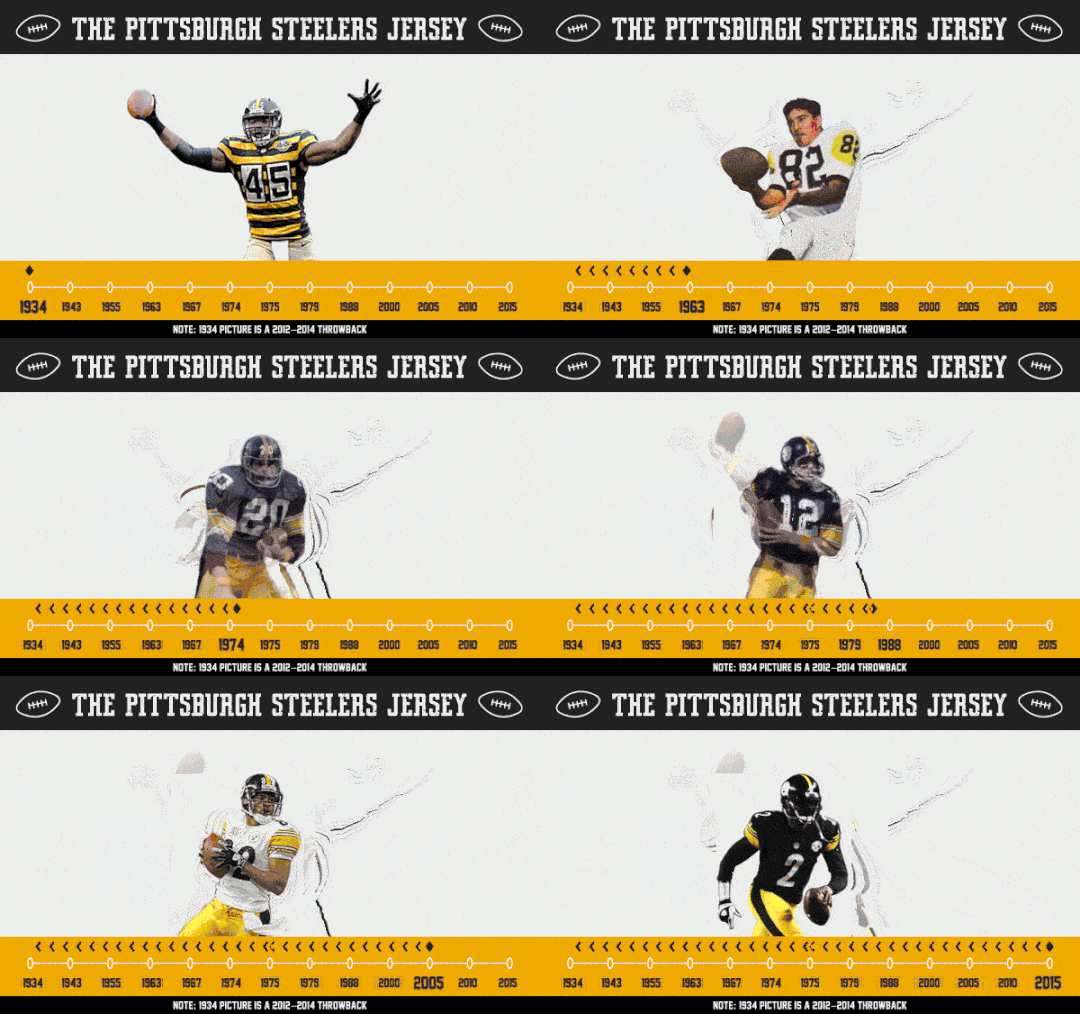
1933: Sports promoter Art Rooney purchases an NFL franchise for $2,500 with the intentions of converting his semi-pro team, the Majestics, into a pro team. As was tradition at the time, Rooney changes the name of the team to the city’s baseball team name, the Pirates.
The 1933 jersey is engineered to give the ball carrier as much of an advantage as possible: The black vertical stripes on a gold background are actually raised felt, meant to cause friction against the ball when the carrier presses it to his body to reduce the possibility of fumbles. The original 1933 jersey also bears the coat of arms for the City of Pittsburgh on its chest as a way of getting the hometown crowd behind them.
The 1933 jersey is no longer thought to exist, and no high-definition photos or diagrams are available. When the Steelers sought to recreate the jersey for its NFL 75th Anniversary throwback in 1994, they were unable to make a faithful reproduction, as the exact design of the coat of arms is also lost to time. The throwback featured non-raised stripes and the current city crest.
Despite the jersey’s engineering, the ’33 team finishes 3-6-2. The team would not finish above .500 until 1942.
1934: The 1934 jersey features raised stripes running horizontally. Instead of the coat of arms, two black-framed black-on-white number panels appeared on the chest – a unique feature among NFL jerseys. It will be this jersey that will become the “bumblebee” throwback.
Uni-Watch investigated this jersey and found the team only wore it during one game in 1934, instead of the 1933 jersey. This game, based on photographic evidence from the University of Pittsburgh, was the November 12, 1933 game against the Brooklyn Dodgers, which the Pirates/Steelers won 32-0. For most of its games that year, the team wore either a solid yellow jersey with black chest numbers, a black jersey with gold sleeve bands and chest numbers, or a yellow jersey with wide black sleeve bands and black chest numbers. Many suspect that the team wore the city crest jersey for four games that year.
Nobody knows why the Pirates/Steelers cycled through so many jerseys that year.
1940: The Pirates change their name to the Steelers in reference to Pittsburgh’s steel industry. To help build morale, the White House asked the Steelers to continue playing – despite the fact that most of the team’s line-up has been drafted into World War II.
1943: To cope with the financial stresses, manpower shortages, and diminished market, the Steelers merge with Pennsylvania’s other NFL team, the Philadelphia Eagles, becoming the “Steagles.” The team plays in both Pittsburgh and Philadelphia and embraces the Eagles’ green and white: The new jersey features white chest numbers and vertical sleeve stripes on a seafoam green jersey. The merged team finishes the 1943 season with the Steelers’ second winning-season record (the first was the year prior).
1944: The Steelers merge with the Chicago Cardinals as a result of an uneven number of teams in the league, forming the “Card-Pitts.” This marks the Pittsburgh franchise’s only winless season. The experiment ends in 1945 when the Boston Yanks permanently merge with the now-defunct Brooklyn Tigers.
1954: The first “modern” Steelers uniform emerges – the black at-home jersey with gold horizontal sleeve bands and gold chest numbers. The helmet transitions from leather to plastic – although, facemasks will not become compulsory until the 1960s.
1960: The latest jersey debuts; it is similar to the 1954 jersey, except that it is tighter. It is unclear whether this was intentional, as logic suggests a looser jersey would afford more comfort and freedom of movement.
1963: This year marks not only the first use of the Steelers’ logo – which is based on U.S. Steel’s three-points logo – but also introduces a new away uniform. The jersey is white with yellow diamond-shaped number patches at the shoulder, black chest numbers, and black sleeve and collar cuffs. The logo is placed on the right side of the helmet only, allegedly because owner Art Rooney was on the fence about it. The right side–only helmet logo is now Steelers tradition.
1966: This year marks the debut of a new home uniform: a black jersey with a yellow diamond “yoke” at the shoulders and collar and white numbers at the chest and high on the sleeves. The Steelers are the only team to use anything other than a rectangular “yoke” on their jerseys. The “Caped Crusader” jersey – so named because it resembles Adam West’s Batman costume – was designed to stand out from other NFL jerseys and to draw attention to the Golden Triangle development in Pittsburgh. The players hated the jersey, and the triangle faded easily.
1974: From the team’s inception until 1971, the Steelers only had eight winning seasons. The ’70s change all this, starting with the 1974 season that nets the team its first league championship at Super Bowl IX. Quarterback Terry Bradshaw, defensive tackle “Mean Joe” Greene, defensive end L.C. Greenwood, defensive tackle Ernie Holmes, and defensive end Dwight White wear the white away jersey with gold horizontal stripes and black shoulders and chest numbers.
1975: A new home jersey follows the 1974 away jersey in design, with a black jersey with gold and white alternating stripes and white numbers on the shoulders and the chest. A white American Bicentennial patch appears on the jersey for Super Bowl X. Bradshaw and the “Steel Curtain” win the Super Bowl this year, as well as in 1978 and 1979.
1988: With minor alterations, the 1974 and 1975 jerseys are still used today. However, in 1988, the Steelers added an “AJR” patch to their jerseys to mark the passing of Rooney.
2000: The Steelers logo patch is permanently added to the jerseys at the left shoulder, and the NFL logo is introduced to the front of the collar – as it is for all NFL jerseys.
The Black, White, and Gold
In 2009, then-governor of Pennsylvania Ed Rendell and then-governor of Arizona Jan Brewer put an unorthodox twist on the traditional governors’ wager on championship games. Instead of daring each other to perform an asinine stunt, the bet dictated that the losing governor would have to treat the winner of an essay contest in the winning governor’s state to an all expense–paid vacation in the losing governor’s state. For Super Bowl XLIII, Rendell had Steelers fans explain why they loved the Steelers, in 250 words or less.
The winner, Cole Hughes, a Residence Inn manager, expressed what many Steelers fans feel about their home team in describing how he and his father dealt with having only one ticket to the 1972 AFC Championship: “My dad, who was a steelworker, somehow came up with one ticket,” Hughes wrote. “We went down to Three Rivers with the hope of getting another. Not one single ticket was even being scalped that day, so it didn’t happen.”
“He wanted me to use the ticket. I wanted him to use the ticket. We went back and forth for 15 minutes outside of Gate A, each insisting the other use the ticket. At 13, I knew enough to insist he use it as he had gone through many losing seasons with the Steelers. I reasoned that this was the beginning of something good and I would get to my share of AFC Championships.”
“I convinced him to use the ticket, which he did, and I took the bus home and listened to the game on the radio with my buddies. We always had a great memory of that day with that one ticket.”
The Steelers of today pale in comparison with the Steelers of the ’70s or even the Steelers of the last decade; but for a city as hard-nosed and hard-working as Pittsburgh, the Steelers are the ideal team. They didn’t see a championship for their first 38 years, they had to fight for respect and recognition, and they were regularly lost in the haze of Philadelphia’s and New York’s flashier teams. Yet the Steelers are still owned and run by a direct descendent of its founder, who never moved, and the team is still the fixture in Pittsburgh society it was more than 80 years ago.
The black, white, and gold have came to represent the tradition of the NFL’s most storied team, and, like the team, the history and evolution of the jersey represents a never-ending passion for what could be and what was.
Sources:
- https://www.post-gazette.com/sports/2009/02/19/Son-s-remembrance-of-Dad-wins-essay-contest-on-Steelers/stories/200902190305
- https://www.si.com/college-football/2015/06/26/college-football-branding-oregon-ducks-tennessee-volunteers
- https://www.sportslogos.net/logos/list_by_team/156/Pittsburgh-Steelers-Logos/
- https://www.steelers.com/history/
